Showing posts with label Vision. Show all posts

Tuesday, May 11, 2010

Senses of the Deep Sea


The most abundant life on this planet is found deep beneath the waves at depths that sunlight hardly penetrates. Species that live at these depths are impossible to capture for behavioural studies where questions can then be asked about how fish at these depths 'see' the world. Thus, deep sea scientists are restricted to undertaking morphological analysis on these organisms and interpreting the results. One of the long held beliefs is that vision becomes less important for fish the deeper you go, and this is obvious when you look at eye size. Generally, after a certain point, when sunlight can no longer penetrate, the size of fish eyes becomes increasingly smaller and the non-visual senses become elaborate and highly specialised. In this post I discuss two papers that investigate what senses are utilised by mesopelagic and abyssal demersal fish species. For those of you who do not know mesopelagic fish are those that swim in the water column at depths of 500 and 1500m while abyssal demersal fish are those found near the bottom of the sea floor at depths of 2000-6000m.

What the author did was capture fish during deep water trawls in the Atlantic and Pacific oceans, and investigate their brain morphology. He described the brains with special reference to the differentiation of the sensory centres - olfactory bulb (smell), optic tectum (vision), octavolateral region (water motion via lateral line), and gustatory lobes (taste). For those who do not know what the lateral line is it is a hair cell based sensory system that detects local water movements surrounding the fish. Such as the wake of a passing prey. By comparing the size of each brain region for a specific species, with the overall average across all species, the author was able to determine whether the fish was a specialist for that particular sensory system.

Some species were 'specialised' in one particular sensory system (mesopelagic fishes 36%; abyssal demersal fishes 40%). Other species 'dominated' in two sensory systems (mesopelagic fishes 49%; abyssal demersal fishes 46%), while the remaining species were generalists and specialised in three senses (mesopelagic fishes 15%; abyssal demersal fishes 14%). No fish therefore were not specialised in any sense.

For mesopelagic fishes that were specialists 92% were masters of vision. This pattern, although not as strong, continues to hold true when you take into account 'dominated' and 'generalist' species. Sixty one percent of fish had above average volumes of the optic tectum. This would suggest that vision is the most important sense in the mesopelagic environment. This pattern is not as strong for abyssal demersal fish with fish specialising in vision in only 50% of cases both for specialists and when dominated and generalist species are accounted for. Vision therefore seems to play a lesser role in the deeper abyss.

The use of the lateral line shows the reverse trend becoming more important the deeper you go. Mesopelagic fish that specialised in the lateral line (25%) were less than those found in the abyss (49%). However, in both environments the lateral line was the second most important sensory system. This pattern of increasing importance of non-visual senses in deeper waters continues to hold for the other senses also. When shifting from the mesopelagic to the abyss, species with above average gustation areas (taste) increased from 10% to 34% , and from 3% to 37% for olfaction.

This pattern shows that the sensory environment of the abyss is markedly different than the open waters of the deep sea. Vision was clearly dominant in the mesopelagic waters, and this may be due to the abundant sources of bioluminescence found in this environment. This is quite evident when comparing the species between the two depth categories. Bioluminescent species were common in the mesopelagic, but not a single bioluminescent species was found in the abyss. With a lack of any visual cues for feeding or mating it is not surprising that non-visual senses begin to become more dominant at greater depth.

Wagner, H. (2001). Sensory Brain Areas in Mesopelagic Fishes Brain, Behavior and Evolution, 57 (3), 117-133 DOI: 10.1159/000047231
Wagner, H. (2001). Brain Areas in Abyssal Demersal Fishes Brain, Behavior and Evolution, 57 (6), 301-316 DOI: 10.1159/000047249
Share/Bookmark

Tuesday, April 13, 2010

Sensory Plasticity in Changing Environments

Can environmental conditions during early development shape individuals phenotypes so they become more adaptive to the conditions they are likely to encounter later in life? Such phenotypic plasticity could provide organisms with the potential to respond effectively to environmental change. One area where such plasticity would be important would be in an animals sensory capabilities. Animals extract information from the environment using a number of sensory systems, and this information guides the animal as it locates food and mates, while also avoiding predators. Thus, the ability to compensate for a deficit in one sense, by increasing the acuity in another, is likely to be of critical importance within sensory disparate habitats. This is what is named the 'compensatory plasticity hypotheses'.

In this experiment the authors raised newly born guppies at low and high light intensities, and then tested their ability to locate food using both chemosensory and visual cues. Guppies, Poecilia reticulata, reared at high light intensities responded best to visual cues, while those guppies reared under low light intensity responded the strongest to olfactory cues. These results confirm the 'compensatory plasticity hypothesis' and shows that these fish have remarkable sensory plasticity. They are able to switch from vision to olfaction in environments where light is limiting.

How this switch occurs is unknown. It may be due to increased attention to sensory signals through learning, neurophysiological changes in the hard wiring of the sensory circuits, or structural changes in the morphology of the sensory unit (i.e olfactory epithelium such as increased lamellae folding) or in the brain itself. In rats that have undergone early visual deprivation you find a reduction in the grey matter within the visual cortex, and an increase in neuron density in the auditory cortex.

The ability to switch sensory modes is likely to be of upmost importance in aquatic ecosystems, which are among the most heavily impacted in the world due to human induced changes. These changes can often result in decreased visibility due to increases in turbidity, or change the olfactory environment through the release of pollutants. How fish species can respond to these changes through sensory plasticity is still largely unknown. Research on larvae of the marine striped trumpeter, Latris lineata, showed that individuals reared in clear water had reduced foraging efficiencies in turbid water. In contrast, larvae reared in turbid water were able to maintain their foraging capability. This suggests that fish are capable of doing so, but to what degree is an area that definitely requires further investigation.

Chapman, B., Morrell, L., Tosh, C., & Krause, J. (2010). Behavioural consequences of sensory plasticity in guppies Proceedings of the Royal Society B: Biological Sciences, 277 (1686), 1395-1401 DOI: 10.1098/rspb.2009.2055
Share/Bookmark

Thursday, April 8, 2010

Do fish have six second memories?


The ability to find food is one of the most important behaviours an animal can undertake, and one of the best advantages an animal can have is to remember where food can commonly be found. Laboratory studies have shown that fish are able to use learning-based strategies to locate food with most studies focusing on the aquatic equivalent of the lab rat - the goldfish. This fish has been shown to typically use visual landmarks to remember a food source within laboratory arenas. In this study the authors used radio tagged common carp to investigate the ability of free ranging fish to undertake similar behaviours. Carp are very closely related to goldfish and share similar feeding habits and sensory cues while feeding. This was undertaken in a highly turbid lake with a water clarity of <>

This study showed that carp could quickly learn and find the location of a food reward in the natural environment. It typically took the carp six days to learn and remember where the food reward was. This matches that found in laboratory trials. Carp were highly nocturnal in their feeding habits and would leave their home range during the night consistently visiting the food reward once the location was known.

What impresses me the most is that they did this at night, in highly turbid conditions, and in a featureless environment. This precludes the use of visual landmarks which is what is typically used by fish in laboratory arenas. It is likely that carp were using olfactory cues to locate the food source rather than vision since carp are known to have an extremely well developed sense of smell. The authors also suggest that the speed with which carp learned to find the food may have been facilitated by social learning as carp and goldfish both learn from shoaling conspecifics in laboratory trials.

This study has some big implications. Firstly, carp are known to undergo extensive movements of 100 km or more. They will often enter areas to spawn that are unstable but predator free, and the ability to remember such locations would significantly improve the survival of their offspring. The ability to remember important sites would therefore be highly adaptive. Another implication is to use this knowledge to reduce the numbers of this fish, which is one of the most invasive species worldwide. By setting up feeding stations you may be able to attract many carp to a specific location within a short time frame and then undertake selective removal.

Bajer, P., Lim, H., Travaline, M., Miller, B., & Sorensen, P. (2010). Cognitive aspects of food searching behavior in free-ranging wild Common Carp Environmental Biology of Fishes DOI: 10.1007/s10641-010-9643-8
Share/Bookmark

Thursday, February 18, 2010

The Eyes Have It


Image: Christopher Hoffman

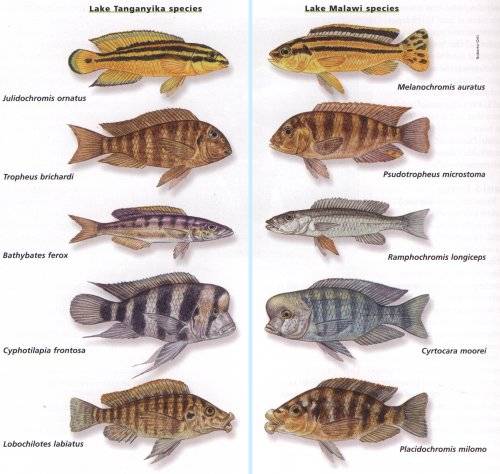
African Cichlids are one of the most speciose groups of fish on the planet and have received a lot of attention from evolutionary biologists due to their explosive radiation. These fish produce new species faster than any other vertebrate on the planet with hundreds of species evolving in the last 120,000 years in Lake Victoria. To put this into context this is much less than the amount of time humans have been a species. One of the reasons for this is due to sexual selection. African cichlids are well known for identifying species specific patterns and colour when selecting mates. This indicates that the use of visual sensory systems is important in this group of fish and a recent study by Meadows (2009) shows how visual tuning may boost African cichlid diversity.

Researchers compared visual sensitivity between cichlids from Lake Malawi, where the water is clear, and cichlids from Lake Victoria, where the water is more turbid. They found that Malawi cichlids were divided into those with opsins that were sensitive to short, medium and long wavelengths. Opsins are a protein that forms part of the visual pigment rhodopsin that is released by the action of light. In Malawi cichlids opsin sensitivity was tuned largely by foraging. For example, cichlids that fed on plankton in the water column had more short wavelength opsins. Short wavelength opsins make a fish more sensitive to ultraviolet light and this is known to increase the fishes ability to detect zooplankton. In contrast, none of the Lake Victoria cichlids showed ultraviolet light sensitivity and instead were most sensitive to red light. In turbid water ultraviolet light is rapidly absorbed and thus it would be maladaptive to be sensitive to this spectrum of light. What they did find is that a gradient existed in fish sensitive to violet light with those found in the clearer parts of the lake showing most sensitivity to violet light, which would provide an advantage when feeding in clear water.

http://www.accuracyingenesis.com/cichlids.jpg

The researchers then showed that changes in gene expression generated large scale shifts in opsin sensitivity (30-100 nm), while changes in DNA sequences fine-tuned opsin sensitivity by 5-10 nm at the extreme ends of their visual range. This could provide a basis for the rapid number of species generated in such a short evolutionary time frame. By changing the way these cichlids see each other and their environment, shifts in opsin sensitivity could lead to changes in their mating and feeding behaviour thus driving speciation.

However, my own research has shown that some cichlids make very good non-visual hunters also. During my postdoc I showed that a Lake Malawi Cichlid from the genus Aulonocara was able to feed using the mechanosensory lateral line. This sensory system is a hair cell based system that detects minute water movements surrounding the fish. Species of Aulonocara are unique in that they possess widened membranous canals, a morphology normally found only in deep sea fish. These fish search similar to a metal detector picking up on the respiratory currents of buried invertebrates within the sand. I also observed these species undertaking aggression and courtship displays within complete darkness. I assume that these behaviours were also mediated by the lateral line. This genus of Aulonocara is one of the most speciose of the African cichlids, and therefore vision may not be the only factor to consider in their rapid speciation.

Meadows R (2009) Visual Tuning May Boost African Cichlid Diversity. PLos Biol 7 (12)


Share/Bookmark